Description
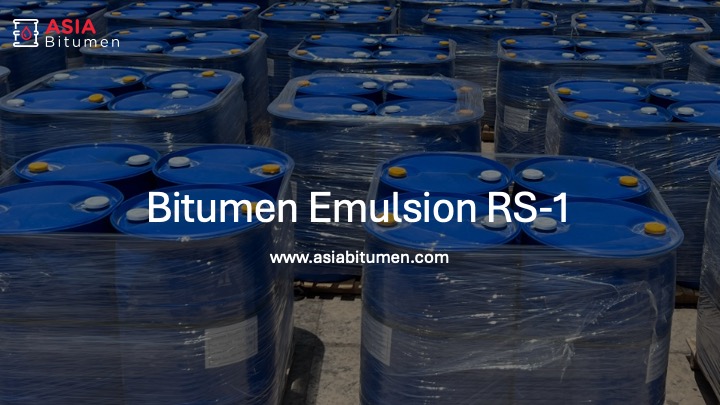
Bitumen Emulsion RS-1 is a rapid-setting cationic bitumen emulsion commonly used in road construction.
What is Bitumen Emulsion RS-1?
RS-1 stands for Rapid Setting – 1
It is a low-viscosity, fast-breaking bitumen emulsion designed to provide quick adhesion to aggregates.
Properties
Type: Cationic rapid setting emulsion
Viscosity:Low
Breaking Time: Fast (ideal when aggregate must bond quickly)
Color: Dark brown when applied turns black once water evaporates
Bitumen Content: Typically ~55–60% (varies by manufacturer)
Common Uses
RS-1 is typically used for:
Tack Coat
Applied between layers of asphalt to ensure proper bonding.
Surface Dressing (First Coat)
Helps seals and binds aggregates in chip seal applications.
Fog Seal / Prime in some cases
But RS-1 is less common as a prime compared to SS-1 or CMS emulsions.
Advantages
Quick setting = reduces construction time
Ensures strong layer bonding
Easy to spray due to low viscosity
Works well in humid conditions
Requires no heating
Safer than using hot bitumen
Application
Tack Coat: 0.20–0.30 kg/m²
Surface Dressing:c1.0–1.2 kg/m² (varies with aggregate size)
Tack coats between existing bituminous surfaces and new overlays.
Chip seals surface dressing (first coat) by binding aggregates.
Spray injection pothole patch repair in some cases.
Standards Specifications often conforms to:
ASTM D2397
AASHTO M140 / M208
Regional road authority standards (e.g., India’s IS 8887)
Technical Data Sheet of Bitumen Emulsion RS-1
Grade / Type: Rapid-Setting (RS-1) bitumen emulsion (cationic or anionic depending on supplier)
Specification of Bitumen Emulsion RS-1 : IS 8887:2018 (or equivalent ASTM where specified)
| Property / Test | Typical / Specified Value | Limits / Notes | Test Method / Standard |
|---|
| Viscosity (Saybolt Furol at 50 °C) | 20 – 100 SFS | — | ASTM D244 / IS 3117 |
| Storage Stability (after 24 h) | ≤ 2% (some suppliers specify ≤ 1%) | – | ASTM D6930 / IS 8887 |
| Residue on 600 µm Sieve | Max 0.05% (by mass) | ≤ 0.05% | IS 8887 Annex-B / equivalent sieve test |
| Particle Charge | Positive (cationic) / or Negative (anionic) depending on grade | — | IS 8887 Annex-E / ASTM D224 |
| Miscibility with Water | No coagulation when mixed with water (i.e. stable emulsion) | — | Water-miscibility / stability test per IS 8887 |
| Residue by Evaporation (Binder Content) | ≥ 60% | ≥ 60% | ASTM D244 / IS 8887 Annex-J |
| Penetration of Residue (25 °C, 100g, 5 s) | 80–150 dmm (some suppliers up to 100–200 dmm) | 80–150 dmm (typical) | ASTM D5 / IS 1203 |
| Ductility of Residue (at 27 °C) | ≥ 50 cm (some suppliers specify ≥ 40 cm) | ≥ 50 cm | ASTM D113 / IS 1208 |
| Solubility of Residue (in Trichloroethylene) | ≥ 98% (or ≥ 97.5% depending on spec) | ≥ 98% | ASTM D2042 / IS 1216 |
| Coagulation at Low Temperature | Nil / No coagulation reported | Nil | IS 8887 / Annex-C |
Additional Typical Qualitative Properties
Emulsion is a free-flowing liquid at ambient temperature.
Rapid setting emulsified bitumen reverts to bitumen quickly after spraying application, enabling fast bonding with aggregate.
High adhesive properties, good penetration into pores of sub-base, compatible with certain cement-treated bases.
No heating required applied cold, making it safer and more convenient than hot bitumen.
Handling and Storage Recommendations
Emulsion should be stored away from freezing or high-heat conditions extreme temps may destabilize emulsion.
Before use drums tanks should be gently agitated or rolled to re homogenize the emulsion.
Apply at ambient temperature; do not dilute with solvents unless specified by manufacturer.






Reviews
There are no reviews yet.